Why peptides are supplied lyophilised
Peptides are chains of amino acids held together by bonds that water slowly attacks. In solution, hydrolysis, oxidation and aggregation all proceed at room temperature, and a peptide that was intact on the day it was made can be a mixture of fragments weeks later. Freeze-drying removes the water, and with it most of that chemistry. The result is a stable, low-mass cake at the bottom of a sealed vial that can be shipped and stored without refrigeration for short periods and kept frozen for long ones.
The trade-off is that the cake has to be rehydrated by the laboratory that uses it. That step, reconstitution, is where most avoidable losses happen.
What bacteriostatic water is
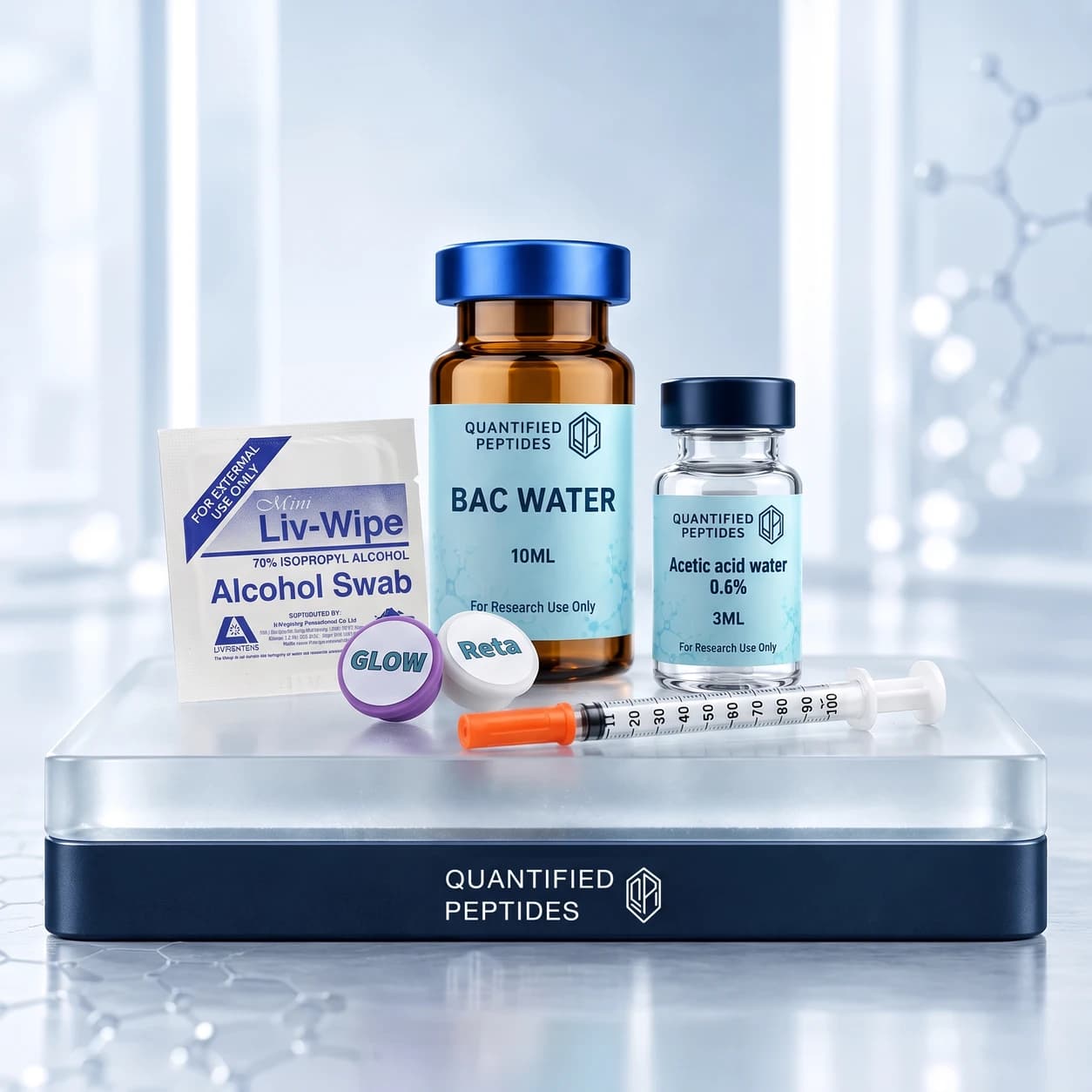
Bacteriostatic water is sterile water for reconstitution with a small amount of benzyl alcohol added as a preservative. The preservative does not sterilise anything; it slows the growth of bacteria that might be introduced when a vial is entered more than once. Sterile water without a preservative is appropriate for a single draw. A multi-use vial that will be sampled over days is where the bacteriostatic version earns its place.
Some peptides are poorly soluble at neutral pH. For those, a dilute acetic acid solution is used instead of water, because a slightly acidic environment keeps the molecule in solution. The supplier's specification for a compound usually names the diluent it was characterised in.
The technique, in outline
Reconstitution is a gentle process. The aim is to dissolve the cake completely without shearing or foaming the peptide, and without introducing anything that was not already in the vial.
- Let the vial and the diluent reach room temperature before opening either. Condensation on a cold vial is water where you do not want it.
- Wipe the stoppers of both vials with an alcohol swab and let them dry.
- Draw the diluent with a sterile syringe and introduce it down the inside wall of the peptide vial, not directly onto the cake.
- Roll or swirl the vial slowly until the solution is clear. Do not shake it. Foam is a sign of shear, and shear denatures peptides.
- Label the vial with the date of reconstitution and the concentration, and refrigerate it.
Concentration is a laboratory decision
The volume of diluent sets the concentration of the resulting solution, and the right concentration is a property of the assay, not of the peptide. A cell-culture protocol, a receptor-binding study and an analytical standard each call for something different. This guide does not give volumes for that reason: the person designing the experiment knows what their method needs, and a number on a supplier's page is not a substitute for that judgement.
Use the diluent we supply
Our replacement and refund promise covers the product as it arrives. Once a vial has been reconstituted with a diluent we did not supply, including bacteriostatic water from another source, or has been stored outside the conditions on its listing, we cannot replace or refund it, and the result is at the laboratory's own risk. The bacteriostatic water and acetic acid water on this site are the diluents the products were characterised with. This does not remove any right under the Australian Consumer Law; the full wording is in the terms of sale.
Stability after reconstitution
Once in solution the clock restarts. Refrigerated, most peptide solutions remain usable for a period of days to a few weeks, depending on the sequence. Freezing a solution extends that, but repeated freeze-thaw cycles cause aggregation, so laboratories that will not use a whole vial at once split it into single-use aliquots before freezing. Light and warmth shorten every one of these figures.
The unreconstituted powder is far more forgiving. Kept frozen, dry and dark, it holds for months. The storage line on every listing on this site states the condition the supplier characterised the product under.
Products in this guide
Supplied strictly for in-vitro laboratory research. Not for human or animal use. Not approved by the TGA or any regulator for therapeutic use. Nothing in this guide is advice on use, dose or outcome.